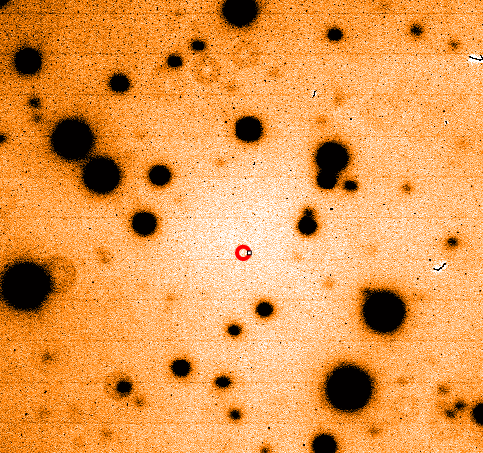
IAU Circ. 7294 : Bursts from the Anomalous X-ray Pulsar 1E 2259+586
-------------------------------------------------------------------
V. M. Kaspi (McGill University/MIT)
report:
F. P. Gavriil (McGill University)
P. M. Woods (USRA/NSSTC)
We have detected several short X-ray bursts from the direction of the anomalous
X-ray pulsar 1E 2259+586, using the PCA aboard RXTE. The bursting behavior was
detected during a routine 15-ks duration monitoring observation which began
June 18, 2002 at 15:39 UTC. In this observation, ~45 bursts were detected,
most of which had duration < 1-2 sec, reminiscent of those seen in soft gamma
repeaters. The mean 1-s flux per burst is approximately 10{^-8} erg/cm^2/s
(2-20 keV). The Chandra-determined position for this pulsar is J2000 RA =
23 01 08.295, DEC = +58 52 44.45 (uncertainty 0".60 in radius, 99% confidence;
Hulleman et al. 2001, ApJ, 563, L49). Observations at other wavebands are
encouraged.
GCN Circ. 1435: AXP 1E2259+586 optical observations
------------------------------------------------------
A. J. Castro-Tirado (Instituto de Astrofísica de Andalucía, IAA-CSIC)
communicate:
R. Rebolo and J. I. González-Hernández (Instituto de Astrofísica de
Canarias)
N. O'Mahony (Isaac Newton Group of Telescopes)
M. A. Alcaide (Universidad de Valencia)
"Following the detection of SGR-like behaviour from the
anomalous x-ray pulsar 1E 2259+586 by RXTE (IAUC#7924, GCN#1432),
we have observed the field with the auxiliary port camera
at the 4.2-m William Herschel Telescope at La Palma on
June 20, 02:53-03:35 UT. We do not find optical emission
within the Chandra 0.6" radius error circle (Hulleman et
al. 2001, ApJ 563, L49) down to limiting magnitudes of
R = 24.8, I = 20.0."